If you’ve never had pet insurance before, the terminology alone can be confusing — deductibles, reimbursement rates, waiting periods, annual limits. In this guide, you’ll learn exactly how pet insurance works from the moment you enroll to the moment you get reimbursed, plus a real-world example showing how the math plays out on an actual vet bill.
The Basic Idea Behind Pet Insurance
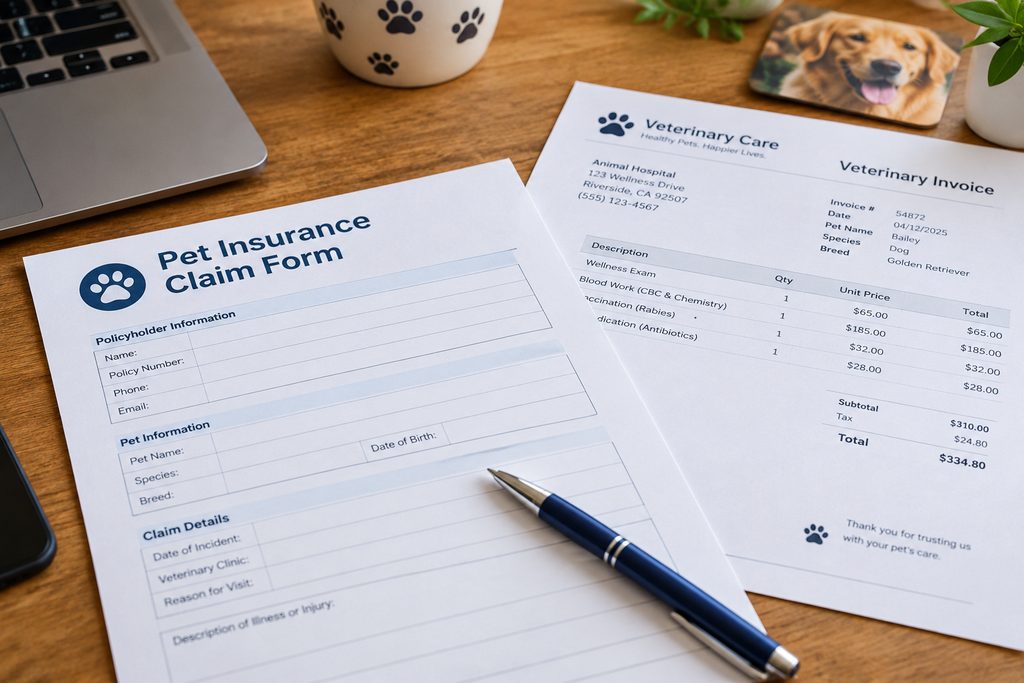
Pet insurance works on a reimbursement model, which is different from how human health insurance usually works. You pay the full vet bill upfront, submit a claim with your receipts, and the insurer reimburses you a percentage of the eligible costs afterward.
This means your vet doesn’t need to be “in network” — most pet insurance policies let you visit any licensed veterinarian, specialist, or emergency clinic. This is general information, not financial or veterinary advice; always confirm the specific terms with the provider before enrolling.
The Four Numbers That Determine What You Pay
Every pet insurance policy is built around four moving parts. Understanding how they interact is the key to understanding your real cost, not just the monthly premium.
Premium
This is the amount you pay monthly or annually just to keep the policy active, regardless of whether you file a claim. It varies significantly by your pet’s age, breed, location, and the coverage level you choose [VERIFICAR: rango de precios actual según proveedor].
Deductible
The amount you must pay out of pocket before the insurer starts reimbursing you. Some providers use an annual deductible (one threshold per policy year across all claims), while others use a per-condition deductible (a separate threshold for each new illness or injury). This distinction changes your real-world costs a lot, especially if your pet develops more than one health issue in the same year.
Reimbursement rate
The percentage of the eligible bill the insurer pays back once you’ve met your deductible — commonly somewhere between 70% and 90%, though this varies by provider and plan tier [VERIFICAR: porcentajes exactos por proveedor].
Annual limit
The maximum amount the policy will reimburse in a single policy year. Some providers offer unlimited annual coverage, while others cap it. Once you hit that ceiling, you’re responsible for 100% of any further costs until the policy renews.
Waiting Periods: Why Coverage Doesn’t Start on Day One
One detail that catches a lot of new pet owners off guard: coverage isn’t active the moment you sign up. Nearly every provider applies a waiting period — often a few days for accidents and a longer stretch (sometimes weeks) for illnesses — before claims become eligible.
This is why enrolling before your pet actually needs care matters. If your dog swallows something unusual three days after you sign up, the claim might fall inside the accident waiting period and still get approved — but if it’s an illness diagnosed in that same window, it likely won’t.
Pre-Existing Conditions: The Part Nobody Loves
A pre-existing condition is generally any symptom, illness, or injury your pet showed signs of before the policy started or during the waiting period. Most providers exclude these from coverage, and this is arguably the single biggest source of frustration and misunderstanding around pet insurance.
This is also why insuring a pet young and healthy tends to be simpler than insuring an older pet who already has a documented condition — not because insurers are being unreasonable, but because insurance as a concept is built around covering unknown future risk, not existing, known costs.
A Real-World Example: How a Claim Actually Plays Out
Numbers make this much easier to understand than definitions alone. Here’s a simplified example using a common scenario — a dog that needs emergency surgery after swallowing a foreign object.
| Step | What happens |
|---|---|
| Vet bill total | $2,400 (example figure, not tied to a specific provider) |
| Annual deductible | $250 — paid by the owner first |
| Remaining eligible amount | $2,150 |
| Reimbursement rate | 80% (example figure) |
| Amount reimbursed | $1,720 |
| Owner’s final out-of-pocket cost | $680 ($250 deductible + $430 unreimbursed portion) |
Notice that even with insurance, the owner still pays something — insurance reduces the financial impact, it doesn’t eliminate it. That trade-off is exactly what makes the question of whether it’s worth it worth thinking through carefully rather than assuming the answer either way.
Try It Yourself: Reimbursement Calculator
Plug in your own numbers to see how a claim would actually break down.
Insurer reimburses: $0
You pay out of pocket: $0
This is a simplified estimate for educational purposes only. It does not reflect any specific provider’s policy, annual limits, or claim review outcome. This is general information, not financial advice.
The Claims Process, Step by Step
- Visit the vet and pay the bill as you normally would — most clinics don’t bill the insurer directly.
- Request an itemized invoice from the clinic; insurers typically need this, not just a payment receipt.
- Submit the claim through the provider’s app, portal, or email, usually within a set window after the visit.
- Wait for review — this can take anywhere from a few days to a few weeks depending on the provider and case complexity.
- Receive reimbursement, typically via direct deposit, for the approved portion of the claim.
Common Mistakes First-Time Pet Insurance Buyers Make
A few patterns show up again and again with new policyholders, and most of them come down to assumptions rather than actually reading the policy.
- Assuming coverage starts immediately. Waiting periods catch people off guard constantly, especially with a newly adopted pet.
- Not asking whether the deductible is annual or per-condition. This single detail can change your annual costs substantially if your pet has more than one issue.
- Confusing wellness add-ons with core coverage. Routine care (vaccines, checkups) is often a separate, optional add-on, not something automatically bundled in.
- Cancelling and re-enrolling later to “save money.” Doing this usually resets the waiting period and can turn anything diagnosed in between into a pre-existing condition.
Frequently Asked Questions
Does pet insurance pay the vet directly?
Generally no. Most pet insurance works on reimbursement: you pay the clinic first, then submit a claim and get paid back. A small number of providers offer direct vet payment in some cases, but this varies by provider and isn’t the default across the industry.
Can I use any veterinarian with pet insurance?
In most cases, yes — unlike human health insurance, pet insurance typically doesn’t use a network of approved clinics. You can generally choose any licensed vet, specialist, or emergency hospital, but it’s worth confirming this detail with each provider before enrolling.
How long does it take to get reimbursed after filing a claim?
This varies by provider and by how complete your documentation is, ranging from a few days to a few weeks. Missing itemized invoices or medical records are the most common reason claims take longer than expected.
Is pet insurance worth it for a young, healthy pet?
It depends on your risk tolerance and financial situation more than on any universal rule. Some owners prefer predictable monthly premiums; others prefer to self-insure by saving the equivalent amount. There’s no single right answer, which is exactly why this deserves its own dedicated breakdown rather than a quick yes or no here.
This article is general information intended to help you understand how pet insurance works. It is not financial or veterinary advice — always review the specific policy terms with the provider before purchasing.
Sources: North American Pet Health Insurance Association (NAPHIA) · American Veterinary Medical Association (AVMA) — Pet Health Insurance Policy